
Ears are one of the first things you notice about an elephant. They’re hard to miss. But spend a little time around these animals, and you start wondering, why are some so much larger than others? And what exactly are those enormous ears actually doing?
The answer is more interesting than most people expect.
Which Elephant Species Has The Largest Ears?
There are three different species of elephants currently living: the African bush elephant, the African forest elephant, and the Asian elephant. The third species would surpass not only one but even two of the three in the size of their ears. And no, it is not the Asian elephant.
The ears of the African bush elephant can grow as long as 1.8 meters. Some individuals will have ears nearly two meters high. Opening both ears wide, you will find the total area exceeding four square meters. That size is almost equal to that of a large dining table.
The ears of African forest elephants are smaller than those of their savanna counterparts, and the difference is quite noticeable. Since they dwell in dense forests, large ears would be a much bigger disadvantage than an advantage for them. Nature is highly practical in its evolution.
Asian elephants’ ears are the smallest among the three. They are rounder in shape and much smaller. If you were to observe both species together, you would immediately notice the difference. The African bush elephant looks as if it were designed for an entirely different environment, which, in many ways, it was.
Elephant With Biggest Ears: Why African Elephants Have Them

The main reason is heat. The African savannah is one of the hottest, most exposed environments on the planet. African elephants found a way to control their body temperature without having shade, water, or shelter always available.
The ears of elephants have an extensive network of blood vessels located near the surface of the skin. When the elephant moves its ears, the blood in those vessels cools down. In some cases, the temperature can drop by as much as 10 degrees Celsius before the blood flows back to other parts of the body. It is like a self-sustaining cooling system with the only input being the motion of the ears.
The larger the ear, the greater will be the surface area for cooling. African elephants developed bigger ears over their evolutionary timeline to face the hot equatorial climate. It was essential for survival.
Asian elephants inhabit forests and jungles, thriving in shadier, cooler, and more humid environments. They don’t need the same level of thermal regulation. So their ears stayed smaller. The biology followed the environment, as it usually does.
How Do Ear Sizes Help Survival?
Big ears add to an elephant’s size visually. African elephants, when threatened, open their ears wide and confront their enemies directly. The display can be very effective; a mature bull elephant showing the signs can seem gigantic. It is a tactic to threaten, and the result is that most predators will hesitate or leave.
Besides hearing, larger ears seem to be more of a visually impressive feature. Bigger ears do not necessarily mean better hearing for elephants. The anatomy of the inner ear is primarily responsible for hearing capacity, while the size of the external ears does not factor in much. However, big ears aid in the detection of extremely low-frequency sounds, or infrasounds that can travel for miles in open areas.
Using low rumbles, African elephants can communicate over many kilometers through sound. Large ears not only help the elephant to pick up far-off sound waves but also help the herds to stay in contact over wide areas. This type of communication over long distances is a real means of survival in the open savanna.
On the other hand, elephants with smaller ears, like the Asian variety, tend to depend more on the acoustics of dense forests where sound behaves differently. Their habitat shaped their needs, which also manifested in their anatomy.
Do Ear Sizes Vary By Age Or Gender?
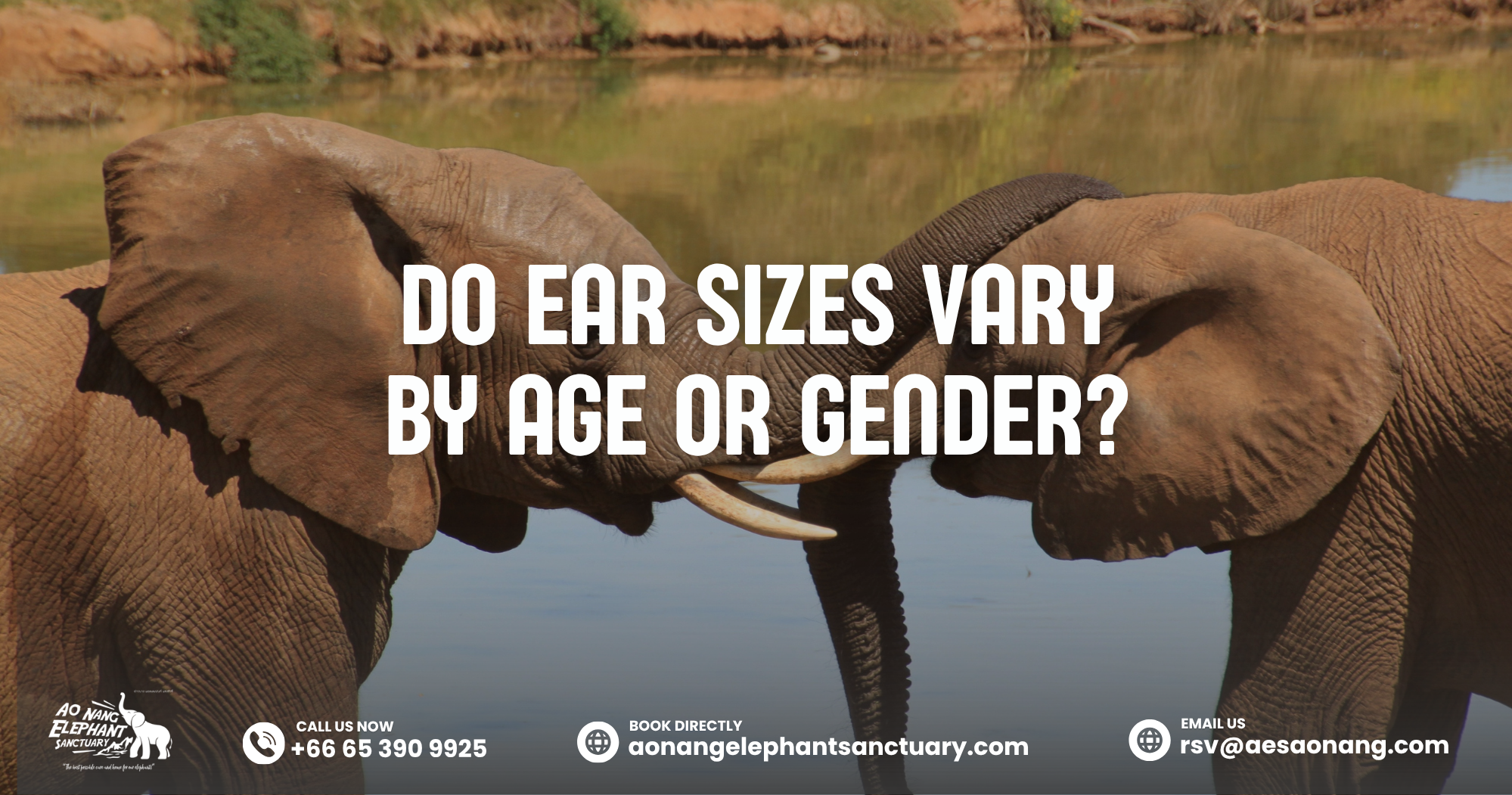
In African elephants, males generally have larger ears than females. But there’s also evidence that ear size plays a role in signaling dominance and maturity among males.
Age matters too. Elephant ears grow throughout their lives. A young calf has relatively small ears compared to its body. As the elephant matures, the ears grow proportionally—and sometimes beyond proportionally in older bulls.
Over time, ears also develop distinctive tears, notches, and markings along the edges. Researchers use these patterns to identify individual elephants in the wild. Each set of ears is essentially a fingerprint—unique to that animal. It’s one of the most reliable identification tools in elephant-field research.
In Asian elephants, the size variation between males and females is less dramatic. But ear shape can still vary between individuals, and experienced mahouts and researchers learn to read those differences over time.
How Do Elephants Use Ears For Communication?
Elephants are quite expressive in the way they communicate, and their ears are actually involved in that.
Ear posture is the most obvious means of expression and communicates a variety of things to those who know how to read it. Ears that are carried wide and brought forward suggest alertness or aggression. An elephant, which sees a threat, will open its ears wide, making itself look as large as possible, and this behavior is a direct and undeniable signal.
Loose ears that droop are a sign of relaxation. These can be found in elephants enjoying themselves, eating, or interacting with familiar members of their herd. This is just one of the many things that good elephant carers know how to observe.
Frequent ear flapping can be a sign that the elephant is excited or irritated. Sometimes, it just means that the animal is forcibly cooling by fanning its ears. Factors like time and location help to understand the situation, and trained individuals can distinguish the signs easily.
More Than Just A Feature

Just glancing at the elephant’s ears, you might think that they are simply large and peculiar features. But they are highly efficient tools with a refined shape that has resulted from millions of years of evolution in response to different environments and needs.
The contrast between the large, map-like ears of an African bush elephant and the smaller, more rounded ears of an Asian elephant is not only a matter of appearance. Each feature tells a story of the origin of that species, the difficulties they encountered, and their means of survival.
Therefore, whenever you encounter an elephant, remember to pay attention to its ears. They are probably the source of the most information after the animals themselves.
If you want to see these incredible creatures up close—and more importantly, elephants that are well-treated—the Aonang Elephant Sanctuary is the place to go. Here, you can enjoy a truly personal, one‑on‑one encounter with them. Visit our website and set up a trip based on the elephants rather than the experience alone.
Reserve your spot now to get a chance to meet Asian elephants!
- Phone: +66 65 390 9925
- Email: [email protected]
- Book directly at aonangelephantsanctuary.com